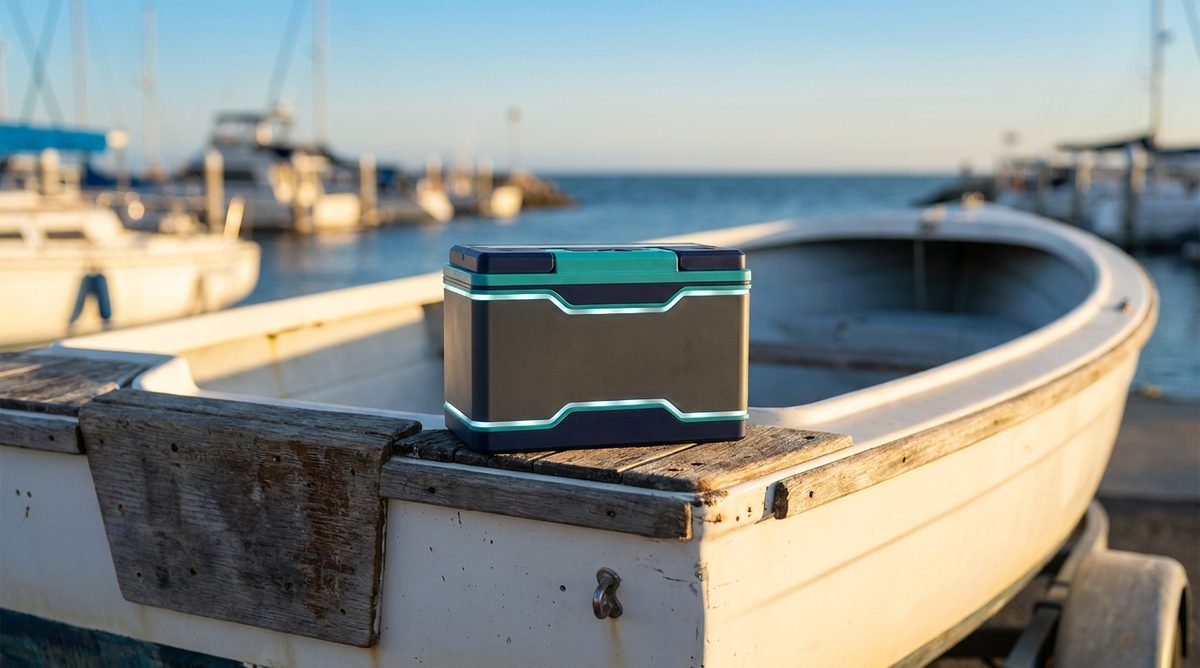
For a trailerable boat's starting circuit, you want a battery with high cranking amps, a sealed maintenance free case, and enough reserve capacity to survive a day of vibration and saltwater exposure. Lead acid marine cranking batteries remain the default in Australia, but sodium ion starting batteries such as the SC-NA1280 offer significantly more cranking power and a far longer service life for boats that use a standard automotive style case size. Always confirm your boat's specific case size and terminal layout before switching.
Nothing ruins a morning on the water faster than a flat battery when you are trying to launch. A marine battery in Australia has to do more than just start the motor. It has to survive constant vibration from wave slap, salt air corrosion, being stored in a hot shed or on a trailer all week, and the odd late season trip where nobody remembers to charge it before launch day. If you are shopping for a marine battery Australia wide, whether for a tinnie with a small four stroke outboard or a bigger centre console with a V6, the starting battery you choose determines whether the engine turns over first go or leaves you drifting.
This guide breaks down what actually matters when buying a starting battery for a boat, compares the lead acid options most Australians default to against newer chemistries, and explains where a sodium ion battery like the ones we build at SaltyCells fits into the picture. We will also cover the difference between a cranking battery and a deep cycle battery, because mixing the two up is the most common and most expensive mistake boat owners make.
Cranking Battery vs Deep Cycle Battery: Know the Difference First
Before comparing brands or chemistries, it is worth being clear on what job your battery actually needs to do.
A cranking or starting battery is built with thinner plates and more surface area, designed to deliver a short, very high burst of current to turn the engine over, then get recharged by the alternator almost immediately. This is the battery that starts your outboard or inboard motor.
A deep cycle battery is built with thicker plates designed to be drained slowly over hours, powering things like fish finders, bilge pumps, livewell aerators, trolling motors, or cabin lighting, then recharged fully afterwards.
Using a deep cycle battery to start an engine works but underperforms, since it cannot deliver peak cranking current as efficiently. Using a pure cranking battery to run your electronics all day will shorten its life dramatically, since deep discharge cycles are hard on thin cranking plates.
SaltyCells sodium ion batteries are built and sold as starting batteries, matched to the same role as a lead acid SLI (Starting, Lighting, Ignition) automotive battery. If your boat runs a separate house battery for electronics, that is a different product category and outside the scope of this guide.
What to Look for in a Marine Starting Battery
Four things matter most when sizing a starting battery for a boat.
Cranking amps. Marine batteries are often rated in Marine Cranking Amps (MCA), tested at 0 degrees Celsius, rather than Cold Cranking Amps (CCA), tested at minus 18 degrees Celsius. MCA numbers read higher than CCA for the same battery because the test temperature is milder. In Australian conditions, where boats rarely start in genuinely freezing weather, CCA numbers give you a conservative, real world margin. Check your outboard manufacturer's minimum CCA or MCA requirement before choosing a replacement.
Vibration and shock tolerance. A boat pounding through chop puts more mechanical stress on internal battery plates than a car on a sealed road. Sealed, maintenance free construction with settled internal components handles this better than older flooded lead acid designs.
Corrosion resistance. Salt air attacks terminals and case fittings. A sealed case with corrosion resistant terminals is worth paying for over an open vented lead acid unit.
Case size and terminal position. Boat battery trays and clamp systems vary. Before buying any replacement, confirm the physical case dimensions and terminal layout fit your existing tray and cabling.
Lead Acid Marine Batteries: The Current Standard
Most Australian boat owners run a lead acid marine cranking battery, typically from brands like Century Marine Pro, Delkor, Predator, or Yuasa Seafarer. These are purpose built for marine use, with thicker plate framing and sealed maintenance free options that handle vibration reasonably well.
The trade off is service life. A lead acid marine battery in regular use, especially one stored on a trailer through an Australian summer, typically lasts 2 to 4 years before cranking performance starts to fade. Heat is the main enemy: the same 40 plus degree days that punish car batteries in western Sydney or regional Queensland do the same to a battery sitting in a boat under a tarp. Lead acid batteries lose capacity faster the hotter they run, and marine batteries often live in hotter, less ventilated spaces than a car engine bay.
Pricing for a quality lead acid marine cranking battery in Australia typically runs from roughly $250 to $450 depending on size and brand, and that cost repeats every 2 to 4 years.
Sodium Ion as a Marine Starting Battery Alternative
Sodium ion chemistry was not originally developed for boats, but the same properties that make it a strong automotive SLI replacement translate well to marine starting duty.
The SaltyCells range is rated for 3,000 or more charge cycles and carries a 5 year warranty, well ahead of the typical 1 to 2 year warranty on a lead acid marine unit. Sodium ion cells also tolerate heat better than lead acid, with a discharge temperature rating down to minus 30 degrees Celsius and stable performance in Australian summer heat, which matters for a battery that might sit in a closed boat hull or on a trailer in direct sun for days between trips. Cranking amps on the SC-NA1280 sit around 900 amps, which comfortably covers most outboard starting requirements up to and including larger V6 four strokes.
The caveat: SaltyCells batteries are built and tested to automotive SLI specifications, in a standard automotive case format. They are not currently sold with a marine specific certification, dedicated marine terminal hardware, or a vibration test rating specific to marine use. If your boat uses a genuine marine case size or specialised marine terminal fitting, a purpose built marine battery may be the safer physical fit. Where your boat already runs a standard automotive size battery tray, which is common on many trailerable boats and tinnies, a SaltyCells sodium ion battery is worth considering as a drop in cranking upgrade. Confirm case dimensions and terminal layout with us before ordering.
Comparison: Lead Acid Marine vs Sodium Ion Starting Battery
| Factor | Lead Acid Marine (Century, Delkor, Predator) | SaltyCells Sodium Ion (SC-NA1260/70/80) |
|---|---|---|
| Typical cycle life | 300 to 500 cycles | 3,000 plus cycles |
| Typical service life | 2 to 4 years | Up to 5 year warranty, longer expected lifespan |
| Cranking amps | Varies, commonly 500 to 800 CCA | 650 to 900 amps depending on model |
| Heat tolerance | Degrades faster in sustained heat | Rated to plus 70 degrees Celsius discharge |
| Maintenance | Maintenance free sealed options available | Maintenance free, sealed |
| Marine specific certification | Yes, purpose built | No, automotive SLI case and rating |
| Typical price (AUD) | $250 to $450 | $275 to $429 |
| Warranty | Typically 1 to 2 years | 5 years |
Which SaltyCells Battery Suits Your Boat
For smaller tinnies and runabouts with a single small to midsize four stroke outboard, the SC-NA1260 (30Ah, around 650 amps cranking, 4.5kg) is the lightest option and easiest to fit in a compact battery box.
For mid sized trailer boats and larger single outboard setups, the SC-NA1270-280 (50Ah, around 860 amps cranking, 6.5kg) offers a step up in capacity for boats that also run some onboard electronics off the same battery.
For larger centre consoles, twin outboard setups, or boats where reliable cold starts under load matter most, the SC-NA1280 (60Ah, around 900 amps cranking, 6.0kg) delivers the highest cranking output in the range.
🔋 The Salty Cells Range at a Glance
Three 12V sodium ion starting batteries. For larger centre consoles and twin outboard setups, the SC-NA1280 delivers the highest cranking output in the range.
30Ah · 650A · 4.5 kg
50Ah · 860A · 6.5 kg
60Ah · 900A · 6.0 kg
Whichever model you are considering, check case and terminal fitment against your existing battery tray before ordering, and reach out if you are unsure.
Frequently Asked Questions
Physically, many boats use the same case sizes as automotive batteries, so a car style SLI battery like SaltyCells sodium ion range can work as a cranking battery in boats with a matching tray. It is not designed as a deep cycle house battery for running electronics for extended periods.
CCA is tested at minus 18 degrees Celsius, MCA at 0 degrees Celsius. MCA numbers read roughly 25 percent higher than CCA for the same battery because the test is done at a milder temperature. Check which rating your outboard manufacturer specifies before comparing batteries.
A typical lead acid marine cranking battery lasts 2 to 4 years in regular use, shorter if stored in direct heat or left partially discharged for long periods. Sodium ion batteries are rated for 3,000 plus cycles and carry a 5 year warranty, suggesting a considerably longer service life under the same conditions.
Yes, ideally. Running electronics off the same battery used to crank the engine risks draining it below the point needed for a reliable start. Many boats run a dual battery setup with a dedicated house battery and an isolator or switch.
Possibly, if your boat uses a standard automotive case size. Confirm exact dimensions and terminal position with SaltyCells before purchasing, since we have not yet published confirmed fitment for specific boat models or marine specific case sizes.
Conclusion
A reliable marine battery is the difference between a smooth day on the water and a call to the tow truck at the boat ramp. Lead acid marine cranking batteries remain the proven, purpose built default, but they come with a shorter service life and recurring replacement cost every 2 to 4 years. For boats running a standard automotive case size, a SaltyCells sodium ion starting battery offers stronger cranking power, far higher cycle life, and better heat tolerance for Australian conditions, at a comparable price point. Check your case size, confirm fitment, and shop the SaltyCells range to find the right cranking battery for your boat.