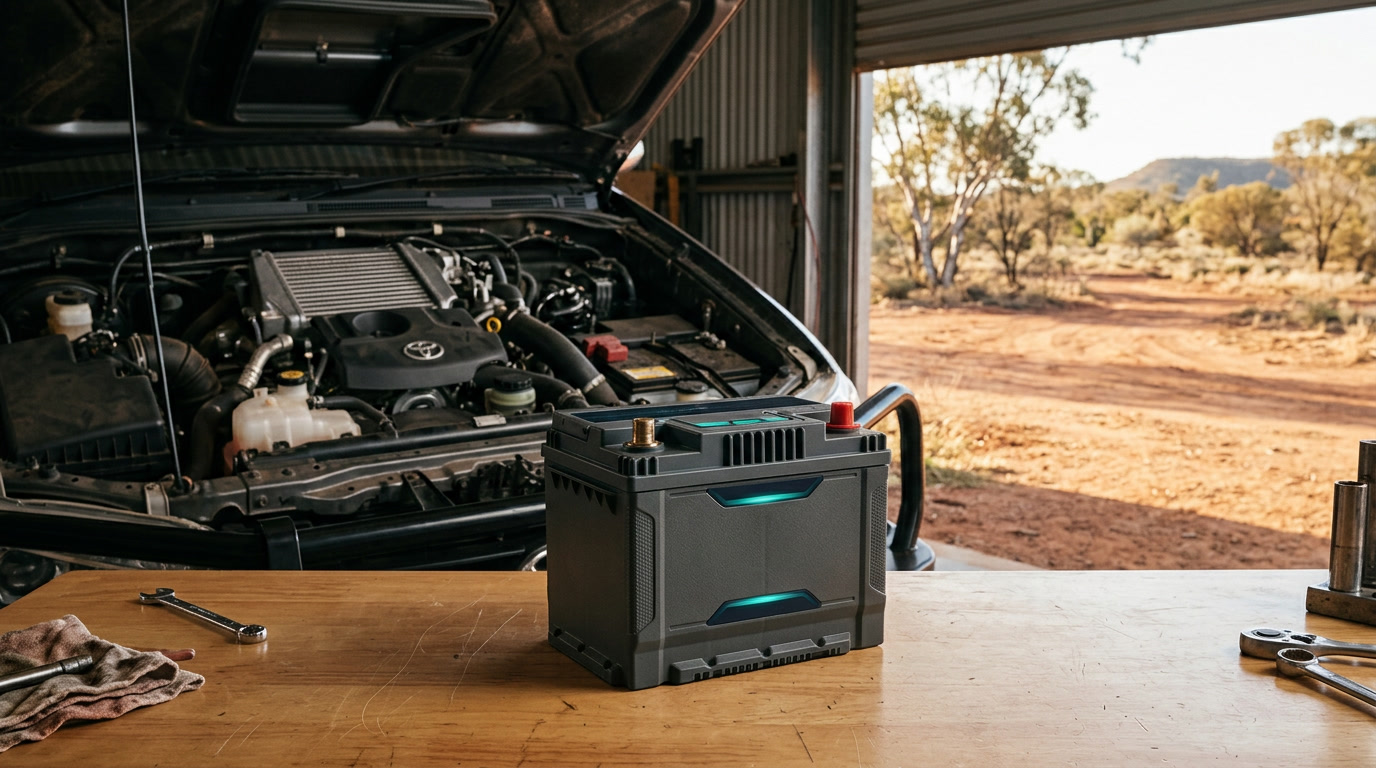
A petrol Toyota HiLux typically needs a battery rated between 430 and 620 CCA (D23 size class). A diesel HiLux needs more cranking power, typically 650 to 750 CCA (D31 or N70 size class). More CCA than the factory minimum will not damage your HiLux, it simply adds a safety margin for cold mornings and an ageing battery.
If you have searched toyota hilux battery cca australia, you are probably standing in front of a shelf of batteries trying to work out which number actually matters. Cold cranking amps, or CCA, tells you how much current a battery can deliver for 30 seconds at minus 17.8°C before its voltage drops too low to keep cranking. For a HiLux, the right CCA depends mostly on one thing: whether you are running petrol or diesel. Get it wrong on the low side and you risk slow, weak starts as the battery ages. Get it right, or slightly higher, and you buy yourself margin. Here is exactly what each HiLux variant needs, and why the number on the box matters less than people think once you go above the minimum.
CCA by HiLux Variant
| HiLux Variant | Battery Size Class | Typical CCA (standard replacement) |
|---|---|---|
| Petrol (2.7L Workmate, SR, SR5) | D23 (e.g. 55D23L) | 430 to 620 CCA |
| Diesel (2.8L, 3.0L turbo diesel) | D31 or N70 (e.g. 75D31L, N70ZZ) | 650 to 750 CCA |
| Older diesel (LN series) | N70 | 650 CCA and up |
Diesel engines have a higher compression ratio than petrol engines, so the starter motor has to work harder to turn the engine over, especially from cold. That is why diesel HiLuxes are specced with a noticeably higher CCA battery from the factory, and why fitting a diesel spec battery to a petrol HiLux (or vice versa) is the wrong move even if the case physically fits the tray.
Does More CCA Than I Need Cause Any Harm?
No. A battery only supplies the current the starter motor actually draws. If your HiLux's starter needs 500 amps to turn the engine over, a battery rated at 750 CCA is not going to force extra current through the system, it simply has more capacity in reserve. The starter takes what it needs and no more. The only real downside to buying more CCA than your HiLux requires is paying for headroom you may not use, and possibly a heavier or larger case than your tray allows. There is no mechanism by which too much CCA damages a starter motor, alternator, or wiring loom.
Where extra CCA genuinely helps is as your battery ages. Lead acid batteries lose cranking capacity gradually as they sulfate and their plates corrode, so a battery that started life at 750 CCA might only deliver 500 CCA after two Australian summers. Buying toward the higher end of your variant's CCA range, or upgrading to a chemistry that resists that decline, buys you a longer window before cold mornings start catching you out.
Why Australian Conditions Make This Trickier
Heat, not cold, does most of the damage to a HiLux battery in Australia. Under bonnet temperatures on a 40°C day towing a van or loaded up for a beach track can push well past 60°C, and that heat accelerates the internal corrosion and water loss that quietly eat away at a lead acid battery's CCA rating over time. So the CCA figure printed on a brand new battery is really a best case number. The real question for a HiLux owner is not just what CCA do I need on day one but what CCA will I still have in year three, which is where heat tolerant chemistry matters as much as the starting number.
The Sodium Ion Alternative
SaltyCells builds 12V sodium ion starter batteries as drop in replacements for the lead acid batteries above, sized to the same D23 and D31/N70 classes. Sodium ion cells are rated for 3,000 plus cycles versus roughly 300 to 500 for lead acid, and they are discharge rated from minus 30°C to 70°C, which means the CCA figure on day one is far closer to the CCA figure in year three because the chemistry is not degrading the way lead acid does in Australian heat.
🔋 Match Your HiLux to the Right SaltyCells Battery
We are still building our verified fitment database for the new sodium ion range, so before ordering, send us your HiLux's year, engine, and current battery part number and we will confirm fit and terminal orientation.
30Ah · ~650A peak · 4.5 kg
50Ah · ~860A peak · 6.5 kg
60Ah · ~900A peak · 6.0 kg
Read more on the underlying chemistry in why sodium ion beats lead acid.
Frequently Asked Questions
Most diesel HiLux models use a standard replacement rated between 650 and 750 CCA, in a D31 or N70 size class battery.
Petrol HiLux models typically use a D23 size class battery rated between 430 and 620 CCA.
No. The starter motor only draws the current it needs, so extra CCA is unused reserve capacity, not a risk. Just make sure the case size and terminal layout still match your tray.
Australian heat accelerates internal corrosion and water loss in lead acid batteries, which lowers the effective CCA well before the battery physically dies. This is the main reason HiLux batteries feel weaker every summer.
Yes, sodium ion starter batteries are designed as drop in replacements using your existing tray and leads. Confirm dimensions and terminal orientation with us first, then follow our installation guide.
The Bottom Line
Petrol HiLuxes need roughly 430 to 620 CCA, diesel HiLuxes need roughly 650 to 750 CCA, and buying above that minimum is safe, it just costs a little more up front. The bigger lever for a HiLux owner in Australia is choosing a chemistry that holds its CCA rating through summer after summer instead of one that quietly loses it. Shop the SaltyCells range to see the sodium ion option sized to your HiLux.